Stay current with daily updates: The Taxi News
UK public safety campaigns: Cabwise and Taxiwise
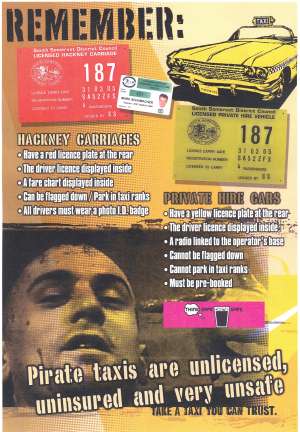
This attention-getting poster, issued by the South Somerset District Council, is part of a public safety campaign in England to warn cab users about the dangers of riding in unlicensed cabs during the 2006 holiday season. The national campaign is dubbed Taxiwise. The Mayor of London is leading the Cabwise program which facilitates getting a legal taxi or minicab with the help of text messaging. The Taxiwise and Cabwise programs are endorsed by celebrities and are receiving a high level of press attention throughout the UK.
Similar warnings to women were issued from Dover District Council and Kent Police, Melton Council, and by the licensed minicab drivers of Croydon. In addition, the cities of Lancashire, Dartford, and Solihull will set up cab marshalling stands in the city centers to ensure passenger safety and discourage illegal operators. An anti-pirate patrol will operate during high-demand hours in Peterborough.
Unlicensed cabs in England are notorious for passenger rapes. According to Transport for London, illegal minicab drivers in that city are responsible for at least ten sexual assaults a month.

Business tax
The San Francisco Tax Collector has determined that taxicab drivers working as independent contractors are subject to the annual Business Tax. All cab drivers will qualify for the lowest rate, $25 per year, and there will be no effort to seek back taxes from previous years. Watch your mail for a bill to arrive soon.
MHA Newsletter
October 2007 MHA Today newsletter in pdf format (696KB).
July 2007 MHA Today newsletter in pdf format (608KB).
February 2007 MHA Today newsletter in pdf format (314KB).
The December 2006 MHA newsletter is here in PDF format:
- Lead story on the Taxi Commission Health care Committee
- Words and Deeds: Profile of Sterling Jenkins
- MHA Dispatches: Business Tax, BSX medallion exchange, Letters from TC and more
- Medallion holder Murai and her art
The September 2006 newsletter has articles on Heidigate, the Goldman Report and Tightening the Screws on Medallion Holders.
Of note in the last year, local and worldwide
-
In July, a Cleveland television station reported on a remarkable way to extract energy from salt water. (5 MB video file)
-
Several papers reported in May on the approval of a plan in New York City to equip all taxis with touch-screen computers for passengers to use. The devices will also facilitate payment with credit cards and are capapble of showing the cab's location on a computerized map. Operators will be required to spend an estimated $7,400 per cab for equipment and wireless services over the next three years.
-
The February 14, 2007 edition of the SF Weekly published an expose of fraud among post-K medallion holders. Baby You Can Drive My TAXI by A.C. Thompson reports that Taxi Commission staff identified 150 cases of egregious fraud during a recent waybill audit. A total of 500 are said to be "bilking the system."
-
Also on February 14, 2007, BeyondChron published an opinion piece by former San Francisco supervisor Matt Gonzales. The Making of a Debit Card Monopoly discusses plans to equip taxis for processing paratransit with a debit card.
-
The SF Examiner ran a front page story on February 9, 2007 reporting on the PC&N survey results regarding dispatch. The article says that a cab arrives just half the time, and that 95% are no-shows on Friday and Saturday nights. The article is not online. See MHA's critique of the badly flawed 2007 PC&N and dispatch survey.
-
The Washington Times reported on January 30, 2007 that Barwood Inc., with a fleet of 400 taxis in the Washington area and in business since 1964, filed for bankruptcy protection. According to Insurance NewsNet, the company lost a jury verdict to an injured customer for $3 million. Barwood officials also blamed the region's low unemployment rate and driver licensing requirements that take up to 90 days to complete, which discourages potential drivers from working. The local cab industry was criticized in a series of newspaper articles during 2003, which led to legislative reforms in 2005. The reforms restricted the transfer of licenses, limited the acquisition of new licenses, and set rigorous standards for taxicab operators. Barwood will continue operation but will phase out its current practice of renting company-operated vehicles to drivers on a daily basis. The company will move to an owner-operator model in which drivers purchase and maintain vehicles.
-
The February 8, 2007 Shanghai Daily reported that 1916 illegal taxis have been detained since a crackdown on illegal operation began earlier this year.
-
Focus News Agency (Sofia, Bulgaria) reported on February 12, 2007 that half of the 12,000 taxis operating in Sofia are illegal.
-
On February 15, 2007 Flett Exchange recieved its first-ever bid for taxi medallions in excess of one million dollars. The bid was made for a pair of New York City mini-corp fleet-operated medallions.
-
On February 7, 2007 Chicago taxicab drivers Mir Sadiq Ali and William Bundy were awarded free taxicab medallions worth about $80,000 each for their outstanding service as drivers of wheelchair-accessible vehicles. Numerous media reported the story.
-
CBC (Canada) reported in January 2007 that the Ottawa city council decided to increase the number of wheelchair-accessible taxi licences following a complaint from Vancouver Mayor Sam Sullivan. The visiting mayor uses a wheelchair and was unable to get timely service from the current 25 accrssible cabs.
-
The Anchorage Daily News reported in January 2007 that the state Supreme Court has ordered the City of Anchorage to let voters decide whether to give a taxi permit to any qualified person who pays the permit application fee. Currently Anchorage permits are sold only at public auction and were recently valued as high as $125,000 apiece. In its ruling, the court determined that taxi permits are not a public asset, but did not decide if they are private property or if current medallion owners will be compensated if the voters eliminate the value of their purchased permits.
-
In December 2006 the Chicago Department of Consumer Services auctioned 50 taxi medallions with a minimum bid of $60,000. The highest bid, a record, was $81,002 according to Crain's Chicago Business. The lowest winning bid was $77,250. A total of 204 bids were received. Crain's reports that all 50 medallions went to six individuals. The top price for a Chicagio medallion in 2004 was $47,500. The lowest price in recent years was $42,000 in 2001. There are currently about 6300 active medallions out of 6900 that have been issued.
-
According to a December 12, 2006 press release, all of the Seattle-Tacoma International Taxicab Association (STITA) taxis will run on compressed natural gas by the summer. STITA operates 166 of the 502 cabs in Seattle.
-
The Australasian Bus News reported on December 11, 2006 that Lime Taxis (backed by Macquarie Bank) have begun operating in Sydney with 40 Mercedes vans. Another 50 are planned to be on the streets by next March.
-
Under a bill passed December 6, 2006 New York City taxi regulators will extend the service life of clean burning and accessible cabs to five years, two years longer than is allowed for regular taxis. Of the 13,087 authorized yellow cabs, currently just 294 are green cabs and 32 are accessible cabs.
-
Singapore-based ComfortDelgro will expand its taxi fleet operations in the United Kingdom according to the Singapore News edition of December 6, 2006. The firm acquired Computer Cab of London in 1997 and has since grown its taxi fleet to about 4000. The firm also operates licensed radio taxis in Birmingham, Aberdeen and Edinburgh in Scotland. Expansion plans include a central booking center located in Aberdeen to handle all taxi-bookings throughout the country, and buying into smaller taxi fleets in cities like Manchester and Newcastle, and in Scotland.
-
The Shanghai Evening Post reported on December 5, 2006 that a Shanghai taxi operator has equipped 2,500 of its cabs with global positioning systems to control the dispatch time to within 30 seconds.
-
International Information Agency, Inc. (IIA) announced December 5, 2006 that they will immediately begin offering American media/marketing companies the exclusive rights to advertise on over 6,000 taxis in the Beijing market, host city of the 2008 Summer Olympics. Advertisers will have the opportunity to place ads on taxi's back panels, interior partitions, and passenger seat partitions essentially branding the entire taxi.
-
The city of Ottawa and the taxi drivers' union will jointly pay for an ad campaign during the holiday season to warn residents about the dangers of using illegal rogue taxis.
-
Flett Exchange introduced an online trading service for New York City taxi medallions on November 30, 2006.
-
Taxi drivers in Rome, Italy are at odds with a city plan approved on November 1 to issue 1,000 new licenses for taxis in 2007, 500 more in 2008 and 800 more in 2009, which, added to the present 6,000 in circulation, would give a final total of 8,300. Currently there are 2.9 taxis for every 1,000 inhabitants in Rome. By comparison there are 5.3 in Paris, 8.3 in London and 9.6 in Barcelona. Rome taxi drivers say that traffic congestion is the main constraint on service, not the number of cabs.
-
Researchers for the Discovery Channel program "Hard Labour" rated the drivers of London black taxis as having the toughest job in the UK. Criteria for "worst" status include the likelihood of serious injury, working hours, skill levels plus mental and physical stress. The ten worst-ranked jobs are: London cabbie; trawlerman; lumberjack; demolition worker; miner; labourer on oil rig; aircraft flight deck officer; abattoir worker; scaffolder; railway lengthman.
-
Houston, Texas has introduced a six-dollar flat rate fare for trips anywhere within the downtown area. The city also established 30 cab-hailing locations marked with curb signs and street decals where passengers can be picked up and dropped off.
-
The Times-Picayune reported on August 31, 2006 that about 500 of New Orleans' 1608 taxi permits would be recalled by the end of business on August 31. The permits to be recalled have not been renewed by their owners. The deadline for permit renewal is in March of each year.
New Orleans taxi permits were worth as much as $50,000 in the late 1990s, but were worth about half that just before Hurricane Katrina. Values had declined due to a slowdown in the tourist economy and due to increasing encroachment on taxi drivers' turf by van drivers and others.
-
On August 30, Senator Conrad Burns (R-Montana) said that a "faceless enemy" of terrorists "drive taxi cabs in the daytime and kill at night." He was praised by First Lady Laura Bush for talking about terrorism with "civility and respect." Burns later repeated his comments about cab drivers before another group. Read more about Burns' speech in The Billings Gazette. Burns narrowly lost his Senate seat to a Democratic challenger in the November 2006 election.
-
The BSX Taxi Market system, a first-in-the-world electronic trading platform for Melbourne taxicab licenses, went into operation March 28, 2006.
Iraq taxi drivers risk death daily
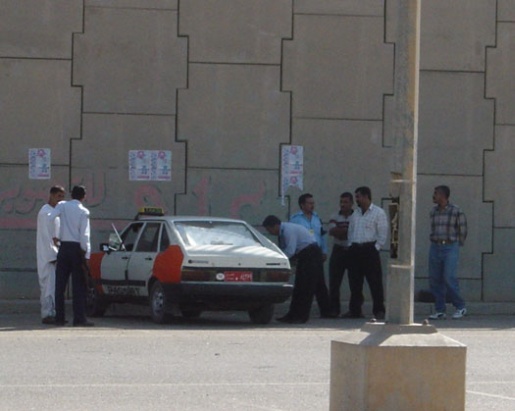 Iraqi police search a taxicab in Baghdad.
IRIN News Service
November 22, 2006
BAGHDAD - Taxi driver Ali Haydar, 36, has to be careful about choosing his customers. Two of his fellow drivers were killed recently when suicide bombers used their cabs to get close to their intended targets and detonate themselves.
"Once a guy got into my car and asked me to just drive him around the city. I found it strange but I needed to work so I couldn't say no. But then I started to feel that this man was dangerous and was trying to find a place to carry out an attack. I asked him what was wrong and he simply told me that he was looking for a place to explode. I stopped at a traffic light and ran from my car, leaving him inside," Haydar said.
"Can you believe it? He was bold enough to tell me that in my face. When I came back to my car, he had left and the police were there. They then accused me of being a terrorist and beat me until some people who knew me intervened and explained to them that I am a taxi driver," he added.
Suicide bombings occur every day in the capital, and cars and taxis are a popular means to this grisly end.
When Haydar stops to pick up a passenger, he has to decide quickly whether the person is a potential threat or not. He looks at their face, checks what they are carrying and thinks about the location they want to go to. He said women and children were always a safe bet.
Haydar has been a taxi driver for more than 15 years, but said the days of when it was safe to drive in Baghdad are gone. He said his old Volkswagen Passat car was imported from Brazil by former president Saddam Hussein's government along with some tanks Iraq was buying.
He worries about it breaking down in crowded places, typical targets for daily bombings. And as his car is his means for his livelihood, he does his utmost to keep it in good condition. "It is an old car, but like every taxi driver, we have no choice but to keep it going because people need to be transported," Haydar said.
Another problem Baghdad's taxi drivers face is the logistical nightmare of getting through the roadblocks and congestion. Over the past two years, many of the capital's main roads have been closed for security reasons, particularly near important buildings, making the already heaving city even more chaotic.
"Places which took 15 minutes to get to before, now take an hour or more - if you are smart enough to take side streets and stay clear of government buildings," Haydar said. "But the number of taxis has decreased in Baghdad after the increase in violence, so I am lucky and can always find someone to pick up."
While passengers are readily available, they do not always have enough money to pay. With no fare counters, haggling in advance is the norm, he said.
"Taxi fares have increased since the price of petrol increased. People are having difficulties paying and there are days when you give to them [by giving them a free ride] rather than them giving to you," Haydar said.
He said he works 17 hours every day, from 6am till 11pm, in order to make enough money to feed his two wives and six children. "I didn't choose to marry a second wife but my family forced me to after my brother was killed and his widow needed a husband," Haydar said.
"When I go home at night, my wives are waiting in worry for me, afraid that something might have happened to me because working as taxi driver in Iraq today is like fighting in a battle," he said.
This article is from IRIN, a UN humanitarian news and information service, but may not necessarily reflect the views of the United Nations or its agencies. All IRIN material may be reposted or reprinted free-of-charge. IRIN is a project of the UN Office for the Coordination of Humanitarian Affairs.
Commentary on the Chicago medallion auction
Courtesy of the Chicago Dispatcher and George Lutfallah, November 2006
Medallions, Tulips and Trends
Some points to consider before investing in a Chicago medallion
By George Lutfallah
Before you jump on the speculative bandwagon that has medallion prices going through the roof in the near future, take a step back and ask yourself what the price of a medallion should be. Why are prices going up? Is there some fundamental change in the industry that is increasing the cash flow to these medallion prices? Certainly the additional revenue from advertising has an impact on cash flow to medallion owners. Increased competition in insurance providers also should have an impact on the bottom line. But there is also a lot of demand currently for Chicago medallions that I suspect may have to do more with speculation than fundamentals. In other words, part of the reason prices may be going up is that there are more and more investors who are in pursuit of Chicago medallions because they are of the belief that prices will continue to go up and they don't want to miss out on the opportunity to get it while they consider prices to still be relatively low. There are also investors out there who may be jockeying for market share, which may lead to the overvaluation of medallions.
The point is that if you're considering buying a medallion, especially if you're a driver looking to buy your first medallion, my advice is to not look at the trends in prices but to sit down with a pencil and paper and see if it makes financial sense to you. You are not going to corner the market in Chicago medallions so don't get caught up in the competition with others who may be operating under that mindset. Figure out your average revenue and expenses. When you have a good estimation of your positive cash flow, ask yourself the following question: Am I better off buying a Chicago medallion at the current price I can get it for or should I invest my money in something else? I am totally in favor of drivers owning their own medallions. But don't just jump in because of what you think medallion prices will do based on the buzz. Sure, prices may continue to go up. As you'll see below there has been a general trend upward in medallion prices.
But I don't advocate looking at trends or following the crowd.
That's the kind of thinking that got a lot of Dutch people in trouble in the early 1600s when seemingly everyone got the idea that tulip bulbs (yes, that's right, the flower) were climbing to astronomical prices. Between 1634 and 1637, people were actually selling their property just to get their hands on these Tulip bulbs because the prices kept rising and, to many Dutchmen at the time, there was no end in sight. People who had sold their tulip bulbs were kicking themselves when they saw the prices of tulips continue to rise and they desperately tried to get back into the tulip business. In the book, "A Random Walk Down Wall Street," by Burton G. Malkiel, one excerpt reads, "Everyone imagined that the passion for tulips would last forever and buyers from all over the world would come to Holland and pay whatever prices were asked for them." Have you heard similar claims about Chicago medallions and how wealthy New Yorkers will continue to come here and keep bidding the prices up? Now I'm not saying that the rise in Chicago medallion prices is necessarily as silly as the rise in tulip bulb prices but I want to point out the similar type of thinking that could cause some investors to fall into a trap.
In Holland, of course the tulip craze ended and prices dropped to the floor, which sent a shock throughout their whole economy leading to a "prolonged depression."
Yes, medallion prices may continue to rise. They might also go down. We all know the story of the owners out there who bought medallions a few years back when prices were high only to see their investments tank. And they tanked for two primary reasons. First, they were overleveraged (Meaning they took on too big of a loan, which made it difficult for them to make their payments). Second, 9/11 happened, which sent a huge shock to the industry and further depressed the ability of many owners to service their loans. At the end of the day, what drives medallion values is the cash flow that starts with taxicab passengers who pay the driver who pays the owner. Advertisers are another source of cash to the owners. There are lots of other factors that I won't get into here now but you get the idea. Look at the fundamentals. Did the population of Chicago explode? Are we gaining huge convention business? How much will the advertising revenue grow? These are the investment characteristics you have to ask yourself before making your investment decision. Grab a pencil and paper and go through the numbers. Think about what that medallion is worth to you and don't base your decision on the belief that somebody may want to pay you more for it down the line. Remember, oftentimes the "winner" of an auction paid too much. Analyze. Don't speculate.
Medallion prices may be depressed and they may be worth more than they were selling for historically. The prices may continue to rise. How much, if at all, is for you to figure out. But just don't base your decision on trends. After all, there was a trend in tulip bulbs in Holland 400 years ago.
Here's some information to help get you started, courtesy of the Department of Consumer Services: 2006 Medallion Prices
The Department of Consumer Services reported 939 medallion sales from January 3, 2006 and October 26, 2006. The average selling price of these medallions was $49,152 and the median selling price was $48,000. The highest price paid was $66,250 on July 31. The lowest reported price paid was $350, which the Department of Consumer Services says was possibly more of a transfer between family members. The second lowest price paid was $20,000 on March 15. The prices reported may or may not include wheelchair-accessible medallions, which would presumably bring the average sales price down as wheelchair-accessible medallions typically sell at a discount to unrestricted medallions.
Of the 939 medallions sold during the period, 60 had sold for $60,000 or more and of those 60 medallions, 55 of them were sold for exactly $61,750 with the bulk of these sales occurring on August 30.
This news digest is for informative purposes only. In accordance with Title 17 U.S.C. Section 107 and The Berne Convention on Literary and Artistic Works, Article 10, news clippings on this site are made available without profit for research and education.
[ Back to top ]
Join the Medallion Holders Association today